← Side Projects
Claude Agent Skill · In the lab

Go from interested in climate to credible in your subdomain

A coached research toolkit that helps transitioning professionals build deep, citable knowledge in the climate tech subdomains they care about.

Where this
stands
Works today
The skill runs end to end: I build a knowledge base with the coach, then generate an analysis brief from it.
Still to build
More features, and the starter knowledge bases that will make the open-source version useful out of the box.
Planned
Open-source release as a Claude Code skill, with a CC BY 4.0 starter knowledge base.
The gap
You've decided to move into climate tech. You've read the overview guides and joined the Slack communities. But when someone asks "what specifically are you focused on?" you don't have a sharp answer yet. The domain is enormous, the information is fragmented across dozens of institutional sources, and the step between general interest and credible depth is poorly served. Existing resources cover the transition. Nothing covers the research.
Built for
Background
PM, engineering, or tech ops, 5-15 years experience
Motivation
Long-term climate impact, not just the next title
Current state
Interested but not yet specialized; overwhelmed by scope
What they need
Depth that transfers into conversations, writing, and interviews
How it works
🌱

KB Coach

The front door

A guided, multi-session process that walks you through building a curated knowledge base about your chosen subdomain. Each session captures sources, organizes claims by analytical dimension, and maps what you know against what you don't. First-session value is landscape understanding, not a finished product.

📄

Report Writer

The payoff

Generates structured analysis briefs from your KB in three formats: market research, technology assessment, or company deep-dive. Each brief includes ACH-grounded root cause analysis, your own scaffolded position, conversation prep, and a full source disclosure. You see exactly what's behind every claim.

One KB. Multiple subdomains. Multiple report types. Sources captured once, cited everywhere.
What a session
looks like

Preflight check

The skill runs a diagnostic (think flutter doctor) that checks your KB's integrity, flags anything that needs attention, and tells you exactly where you stand.

AUTOMATIC

Build your knowledge base

The coach walks you through your subdomain's landscape: anchor institutions, regional policy, capital flows, practitioners, and critics. Each source is captured with full metadata. You curate; the skill organizes.

COACH

See what you know and what you don't

A coverage map shows which analytical slots are filled, which are thin, and which are empty. Gaps aren't failures; they're your research agenda, and the skill names the specific analytical purpose each one blocks.

AUTOMATIC

Generate an analysis brief

Choose a report type. The writer builds an internal evidence grid, runs it through the search gate (you decide if web research is needed), and assembles a structured brief with your sources disclosed and your position scaffolded, not invented.

WRITER

Everything versioned, nothing lost

Every session is auto-committed to git. Come back next week with new sources, re-run a report, and diff the briefs. Your KB compounds over time.

AUTOMATIC
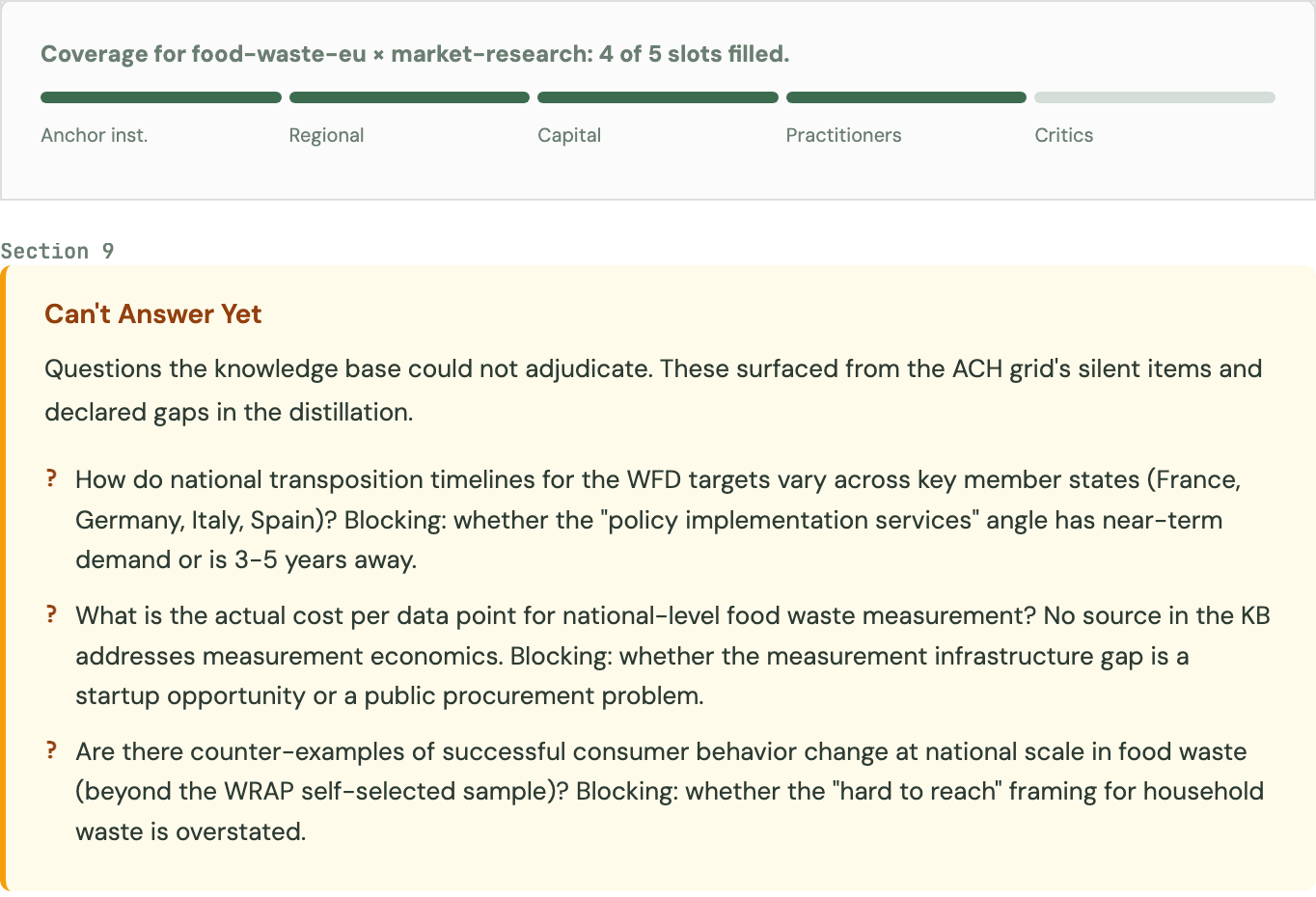
Two parts of a sample brief produced during testing. A coverage bar reads 4 of 5 slots filled, with anchor institutions, regional, capital and practitioners filled and the critics slot empty. Below it, a Can't Answer Yet block lists three questions the knowledge base could not settle, each with the decision it blocks.
Two parts of a sample brief from my testing: the coverage bar shows the empty Critics slot, and "Can't Answer Yet" lists what the knowledge base could not settle and what each gap blocks.
1

Citable landscape coverage

A brief grounded in institutional sources you can name in a conversation, cite in a blog post, or reference in an interview. Every claim traces to a real source; the brief tells you when it can't answer something.

Signal: you use the brief's claims in real professional conversations and published writing.
2

Questions that spark interest

The brief surfaces what your KB can't answer yet and generates questions that lead somewhere. The best outcome isn't a finished analysis; it's the follow-up research you're now motivated to do.

Signal: you act on a question the brief raised, and you extend your KB with questions of your own.
3

Publishable thought piece

A completed draft that demonstrates your depth in the subdomain. Not a summary of other people's work, but your own position, built on evidence, with the reasoning visible. Proof of work for your portfolio.

Signal: you have a draft you'd put your name on, whether or not you publish it.